
In her book The Constitution Is My Home, lawyer Indira Jaising makes an interesting observation: None of our laws contain a definition of marriage. They tell you how to enter and leave a marriage, they list some of the rules and privileges associated with it, but they never explain what a marriage is. When it comes to sexual relationships within marriage, this gap becomes important.
There is probably no greater area in which a person’s dignity and individual autonomy are expressed than in their sexual activity, be it the choice of sexual partner or the question of consent to individual sexual acts. However, not only are sexual relationships generally viewed as an integral part of marriage, but when it comes to marriage, they are often based on the idea of permanent and irrevocable consent, which undermines the idea of sexual autonomy, especially for married women. This has been at the heart of numerous issues, be it marital rape, adultery or the restoration of marital rights.
There is probably no greater area in which a person’s dignity and individual autonomy are expressed than in their sexual activity, be it the choice of sexual partner or the question of consent to individual sexual acts.
Take Section 9 of the HMA, which states that if either the husband or the wife has withdrawn from the other’s company without reasonable excuse, the aggrieved party may apply to the court for an order for restoration of conjugal rights and the burden of proof will be on the party who withdrew to show that his departure was reasonable. Order 21 Rule 32 of the Code of Civil Procedure (CPC) also provides for financial sanctions against a person who has failed to comply with a restitution order.
T. Sareetha v T. Venkata Subbaiah was a case from 1983 in which the plaintiff Sareetha, a well-known film actress, was married to the defendant by her parents at the age of 16 and they had lived largely apart since then. Her husband filed a petition for restoration of his conjugal rights. The Andhra Pradesh High Court struck down Section 9 as violating the right to life and personal liberty under Article 21 and violating Article 14 as it had no legitimate public purpose.
It was recognized that the law was externally neutral and applied equally to husbands and wives. However, it was aware of the different impact of such a decree on men and women and found that it violated Article 14 for this reason too. After marriage, the marital home is usually the home of the man or his parents. When the couple is separated and an application for restoration of conjugal rights is filed, it is generally because the woman has left the couple and is forced to return to a home where she does not want to be. It is also, without exception, the woman who must bear and raise any child born from the couple’s sexual activities, ruining her own plans for her future. The data also showed that the provision was almost always invoked by men against women and very rarely vice versa.
It was recognized that the law was externally neutral and applied equally to husbands and wives. However, it was aware of the different impact of such a decree on men and women and found that it violated Article 14 for this reason too.
The ruling described the provision as tantamount to forced sex and noted that it degraded human dignity and personal autonomy. It also noted with concern the provisions of the CPC, which at that time provided for not only financial sanctions but also civil prison sentences.
Subsequent decisions deviated from this approach. In 1984, the Delhi High Court ruled in Harvinder Kaur v. Harminder Singh that the provision did not constitute forced sex but was merely an attempt to save the marriage. It also distinguished cohabitation from sexual intercourse and held that the law only provided for the possibility of the couple resuming cohabitation, which was the essence of married life. Furthermore, Section 13(1-A) of the Hindu Marriage Act provides for divorce as a result of non-resumption of cohabitation. Therefore, the determination is in a sense the first step towards a divorce in the sense of irretrievable failure, which the parties should welcome if they seek it, while at the same time providing an opportunity for reconciliation.
As regards the sanctions imposed by the CPC, the court ruled that the provision had been changed and a civil prison sentence was no longer a consequence of non-compliance. Financial sanctions remained in place, but these did not significantly bother the court. The Supreme Court in Saroj Rani v. Sudarshan Kumar Chadha accepted the view of the Delhi High Court which currently holds the position.
Ojaswa Pathak v. Union of India is a PIL filed in 2019 by a group of law students challenging the validity of Section 9 of the HMA in the Supreme Court. It draws on the doctrines of constitutional morality, privacy and sexual autonomy that the court has fleshed out in recent years, as well as the disproportionate impact on women recognized in Sareetha. The decision on the petition is still pending and it is unclear which direction the court will take. However, the strongest argument against it has already been made by the court itself in its judgment in Joseph Shine v. Union of India, a 2018 judgment that overturned the criminalization of adultery.
Section 497 of IPC It states: “Whoever has sexual intercourse with a person who is the wife of another man without the consent or toleration of that man, such intercourse not constituting the offense of rape, is guilty of adultery.” In this case, the wife cannot be punished as an accessory to the punishment.”
Even in the problematic area of criminalizing consensual extramarital sex, the law has not done so in the same way, thereby betraying its stated goal of protecting the institution of marriage.
A wife, on the other hand, had no comparable legal recourse if her husband had an extramarital affair, neither against him nor against his lover. In other words, the crime of adultery, part of a chapter on “crimes relating to marriage,” was viewed as a crime committed by another man against a husband, comparable to the theft of property. The woman could not be prosecuted, nor was she prosecuted, because her consent and agency were irrelevant to the transaction between the two men.
Even in the problematic area of criminalizing consensual extramarital sex, the law has not done so equally, betraying its stated goal of protecting the institution of marriage or perhaps revealing the true nature of what it meant by marriage—a man’s ownership of his wife and control over her sexuality. Of course, the law made certain assumptions about the sexual nature and autonomy of women and men, as it was based on the prevailing Victorian morality at the time of its writing.
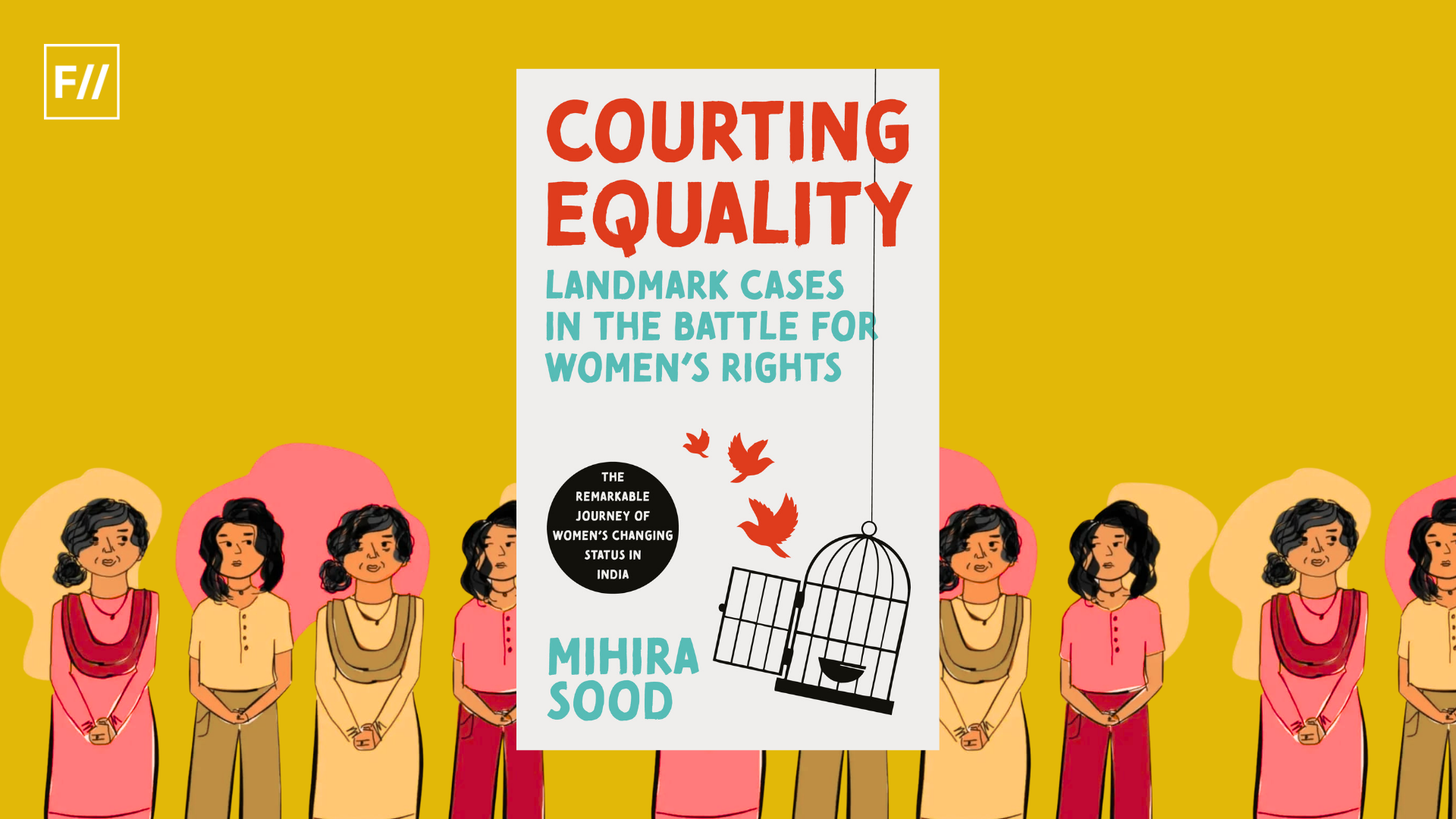
Excerpted with permission from “Courting Equality” by Mihira Sood, Juggernaut Books.
Feminism In India is an award-winning digital intersectional feminist media organization with the aim of learning, educating and developing feminist sensibilities and decoding the F-word among the youth in India.